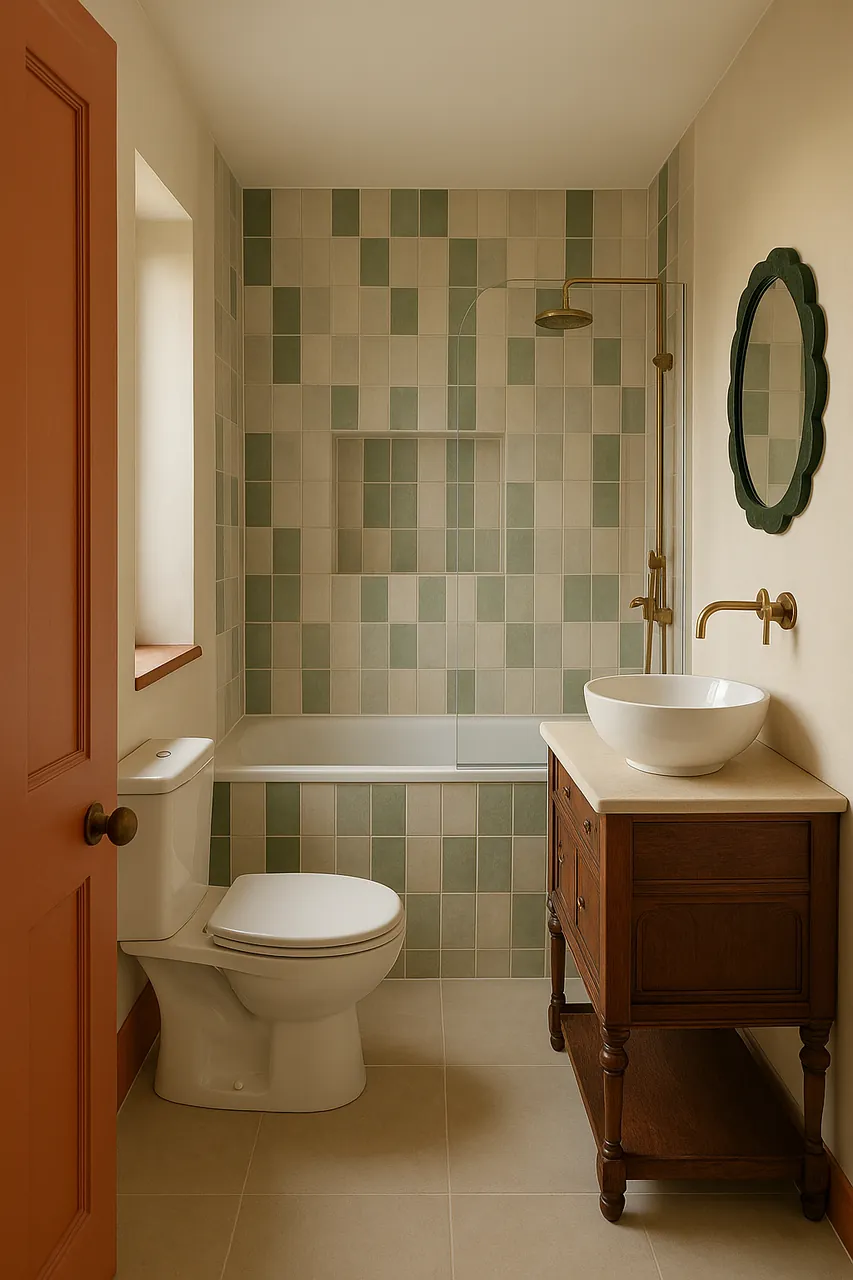
For three years after moving into her flat, Reddit user u/Mysterious-Big-732 knew the bathroom would be her first major renovation. Saving took time: she wanted the room she had planned from the start, not a quick change of fixtures. The finished bathroom keeps the familiar positions of the tub, toilet and sink, but little of the old beige palette remains.
Its most distinctive piece began life outside the bathroom. An old record-player cabinet was stripped, restored and given a stone top and vessel sink. It now stands where a white pedestal sink once left the plumbing area open below.
The original beige bathroom
Large beige tiles covered the walls around the bathtub and continued behind the sink. A narrow black mosaic band crossed both tiled areas, while matching beige floor tiles carried the same colours across the room. Above the pedestal sink hung a wide rectangular mirror.
The tub occupied the back wall, with the toilet between it and the sink. Those fixtures still fit within the same narrow footprint after the renovation. What changed was the way the room’s surfaces, furniture and fittings drew attention to it.
Stripping the room back
This was more than a repaint around the existing bathroom. Removing the wall tile exposed timber framing, pipework, masonry and patches of adhesive. The floor tiles came up too, revealing the boards beneath them. A timber frame near the ceiling showed that work extended above the area previously covered by tile.
During construction, boards covered the tub wall, with a recessed niche cut into its centre. Plumbing and cables were still exposed near floor level before the bath and finished surfaces went back in. Opening up the room allowed the wet area to be rebuilt for the new design.
A record-player cabinet becomes a vanity
The replacement for the pedestal sink has carved wood, panelled doors, turned legs and a lower shelf. Those details make sense when its former purpose is known: it was an old record-player cabinet, not standard bathroom furniture. A furniture restorer in Northumberland stripped and restored it before the conversion.
A pale stone top sits between the wood cabinet and a white vessel sink. Brass fittings are mounted on the wall rather than on the furniture. Together, the top and fittings give the former music cabinet its new role without hiding the features that made it worth reusing.
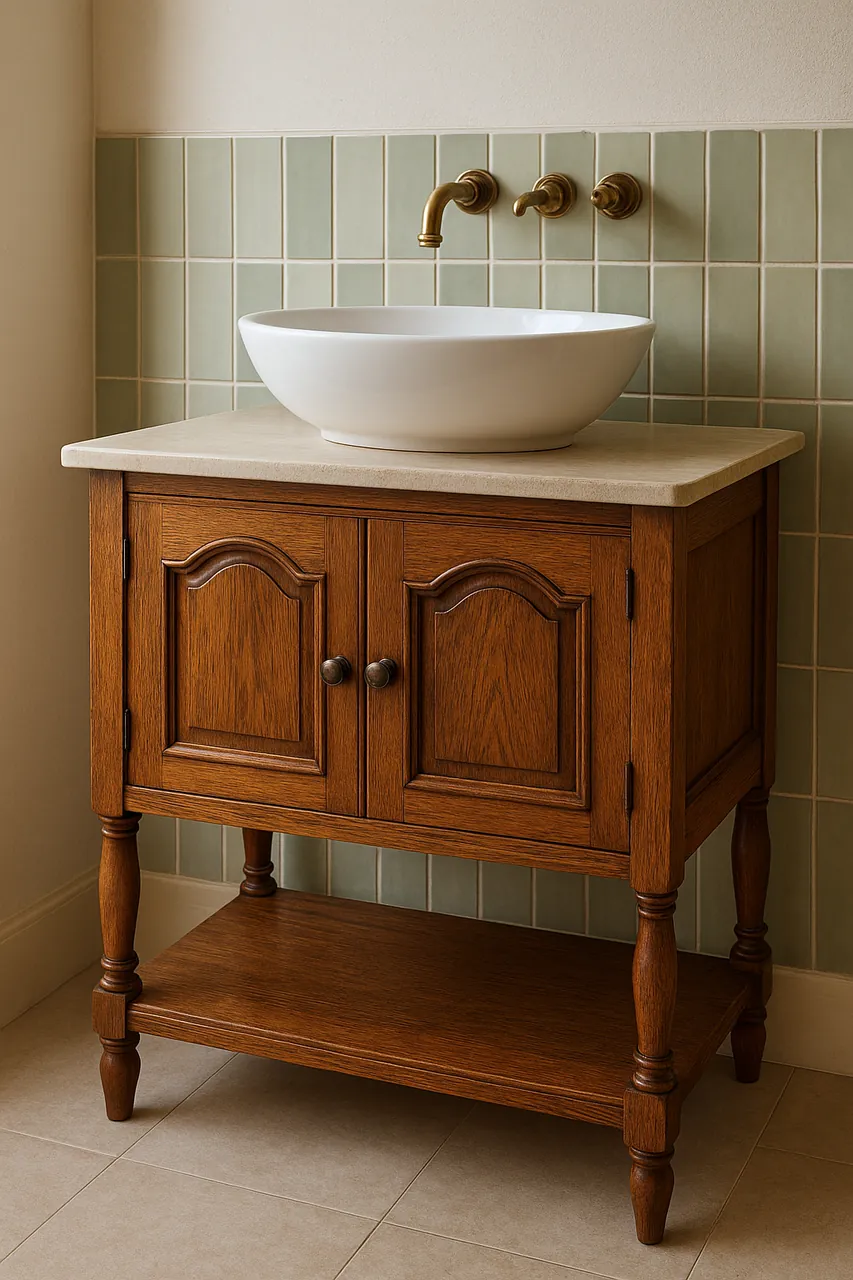
The owner says the vanity cost around £1,200. The whole renovation finished near £14,000, above an original budget of £10,000–£12,000. The cabinet was therefore one part of a much larger bathroom rebuild, rather than a small change presented as the entire makeover.
Vertical stripes around the bath
In place of the beige walls and horizontal black band, green and off-white rectangular tiles run vertically behind the bathtub. Their alternating colours continue across the main tub wall, around the recessed niche and down the bath panel. The niche follows the stripe sequence instead of standing out as a contrasting box.
Brass shower fittings bring a warmer metal into the muted green and pale scheme. A clear screen leaves the tiled wall visible. The vertical pattern also draws attention to the tall walls of the converted 1860s house, where the former horizontal band had cut across them.
The sink area echoes the striped tile without repeating the full tub wall. A shorter tiled section rises behind the vessel sink, linking the vanity to the bathing area while leaving more of the surrounding wall uncovered.
A new mirror for the vanity wall
The broad rectangular mirror has been replaced by one with a scalloped frame. The owner confirmed that its colour is dark green, connecting it to the tile rather than adding another black detail. Its shaped edge also contrasts with the straight lines of the vertical stripes.
Brass wall fittings sit above the sink, alongside a small shaded sconce and hooks. Beneath them, the restored wood introduces a material absent from the old sink area. The vanity is the strongest furniture detail in a room otherwise defined by tile and colour.
Burnt orange on the door and trim
The door and its surrounding trim share a burnt-orange finish. Painting both makes the colour read as one architectural element, rather than a small accent on an otherwise neutral wall. Brass door hardware adds another warm detail.
Dark green visible through the doorway contrasts sharply with the orange. Along with the striped tile and wood vanity, the painted door makes clear that the owner did not replace the old beige bathroom with another restrained, neutral scheme.
The layout stayed, but the room changed
The before-and-after views show how much can change without moving the main fixtures. The tub, toilet and sink still occupy the narrow room, but beige tile, a black mosaic border and a wide mirror have given way to vertical stripes, a scalloped mirror and warmer fittings.
The most unusual switch remains the sink: a pedestal fixture was replaced by furniture made decades ago for a different purpose. Restoring that record-player cabinet gave the bathroom a focal point while preserving its carved doors, turned legs and shelf.